
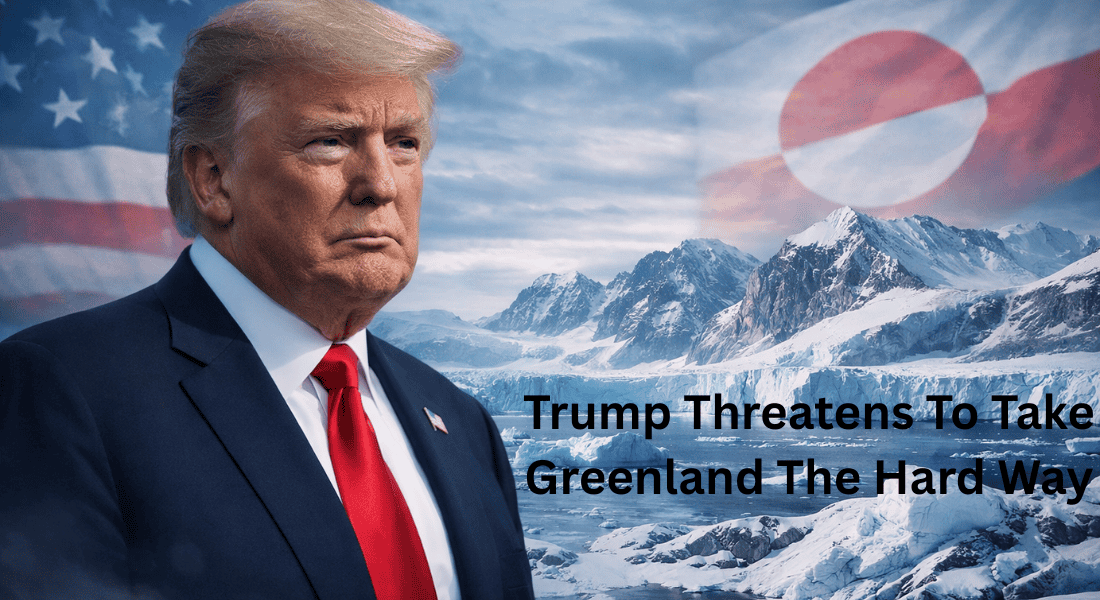
Trump’s Renewed Push for Greenland: Strategic Motives and Rhetoric
In early January 2026, former U.S. President Donald Trump reignited international controversy by publicly restating his interest in acquiring Greenland, a large Arctic island with strategic importance. Trump framed this initiative around U.S. national security and geopolitical competition with Russia and China, asserting that American control would be essential to protect Western interests in the Arctic. His comments have drawn intense opposition from Greenland’s government and European allies, raising concerns about sovereignty, international law, and the future of transatlantic alliances. (Reuters)
Trump’s public remarks made the issue headline news when he stated bluntly: “We are making moves to acquire Greenland whether they like it or not,” asserting that the United States should not cede strategic advantage in the region to other great powers. (Fox News)
In a January interview with The New York Times, Trump went further: “Greenland ownership is psychologically important for me,” and reiterated his belief that “countries have to have ownership and you defend ownership; you don’t defend leases.” (People.com)
This rhetoric underscores Trump’s view that without full control or ownership, the United States would remain strategically vulnerable to influence or incursions by Russia or China. Trump’s framing reflects a worldview prioritizing territorial control as a core component of national power rather than diplomacy or international partnerships. (People.com)
Reports from U.S. officials also show the White House’s willingness to explore all options, including military instruments, to secure Greenland. The White House Press Secretary confirmed that “it is always an option” to use the U.S. military in pursuit of strategic aims. (New York Post)
Learn about all the world politics in our Politics section.
Geopolitical Importance of Greenland
Greenland occupies vast Arctic territory between North America and Europe, making it one of the most significant landmasses in terms of strategic geography. The island is rich in natural resources, including rare earth minerals, critical metals, and potentially large untapped oil and gas reserves. Its landmass is the world’s largest island, home to roughly 57,000 residents, and holds deep strategic significance due to its proximity to emerging Arctic shipping lanes and defense infrastructure. (Reuters)
The Cold War-era Thule Air Base, located in northern Greenland, remains a key asset for U.S. early warning radar and space surveillance, underscoring the island’s longstanding defense value. Although the United States already wields influence via defense cooperation agreements with Denmark, Trump argues that leasing or shared defense arrangements are insufficient without formal U.S. sovereignty. (Anadolu Ajansı)
Also read our Latest Post: UN Security Council Emergency Meeting For Ukraine
Greenland and Danish Government Responses
Greenland’s political leadership has responded with unequivocal rejection of Trump’s claims. On January 12, 2026, Greenland’s government declared it would not accept a U.S. takeover “under any circumstances,” and reaffirmed its desire for self-determination under international law and existing sovereignty arrangements. (The Guardian)
Prime Minister Jens-Frederik Nielsen issued a firm statement emphasizing Greenland’s autonomy and aspirations for independence, stating that Greenland’s future must be decided by its own people, not foreign pressure:
“We do not want to be Americans, we do not want to be Danes, we want to be Greenlanders.” (Hindustan Times)
This unified stance was echoed by leaders of all major Greenlandic political parties, who criticized what they perceive as U.S. contempt for Greenland’s right to self-governance and stressed that any decisions regarding sovereignty must be made without coercion or foreign interference. (AP News)
The Greenlandic leadership’s response reflects deep skepticism toward external powers determining their nation’s territorial fate. Greenland’s officials have called publicly for NATO’s collective defense framework to ensure their security rather than unilateral U.S. actions. (Reuters)
Denmark, which retains responsibility for Greenland’s foreign affairs and defense, has also rejected Trump’s proposals. Danish Prime Minister Mette Frederiksen warned that any attempt to alter the island’s status by force would jeopardize NATO cohesion, reiterating:
“Greenland is not for sale.” (The Guardian)
Denmark’s clear stance reinforces that Greenland’s defense obligations and territorial integrity are rooted in alliance frameworks and existing bilateral agreements, not unilateral acquisition.
International Reaction and NATO Implications
The unfolding dispute has reverberated across international organizations and alliances. NATO officials have been drawn into discussions about Arctic security amid Trump’s statements. Reports indicate that NATO is deliberating ways to reinforce defense commitments without endorsing any singular national takeover of Greenland. (AP News)
European Union leaders and NATO members have expressed concern that any unilateral U.S. attempt to acquire territory from a NATO ally could severely damage transatlantic unity. Some members have suggested that broader defense cooperation models might be needed to counterbalance rising Russian or Chinese activities in the Arctic without undermining alliance solidarity. (The Guardian)
International observers have characterized Trump’s rhetoric as creating a geopolitical conundrum: while Arctic security is a legitimate concern for Western powers, unilateral territorial ambitions run counter to international law and norms of state sovereignty. Many analysts believe that leveraging NATO and multilateral frameworks remains the only viable path to bolster Arctic defenses while respecting the autonomy of smaller states like Greenland. (AP News)
Public Opinion in Greenland
Polling data indicates that the vast majority of Greenlanders are firmly opposed to the idea of becoming part of the United States. According to independent surveys, approximately 85 percent of residents oppose joining the U.S., contradicting Trump’s claim that the population desires American affiliation. (euronews)
This disconnect between U.S. political rhetoric and local public sentiment highlights a fundamental flaw in Trump’s approach: decision-making on territorial status cannot be separated from the will of the people who live in the territory. Greenland’s population has emphasized its desire to determine political status through democratic processes rather than external imposition. (euronews)
More about Geo Politics.
Legal and Ethical Considerations
Experts in international law have pointed out that any attempt by the United States to force territorial change would be inconsistent with long-standing principles of sovereignty, self-determination, and peaceful dispute resolution. Analysts stress that forced acquisition could violate multiple treaties and norms, potentially triggering broader diplomatic fallout. (Anadolu Ajansı)
Legal scholars emphasize that Greenland’s autonomy, as recognized under Danish and international law, cannot be overridden by unilateral power without formal consent and negotiation. Coercive tactics, especially those involving threats of force or military occupation, are widely considered unlawful under the United Nations Charter. (Anadolu Ajansı)
Conclusion: A Strategic Clash with Far-Reaching Implications
The emerging confrontation between Trump’s renewed Arctic ambitions and Greenland’s determination to retain autonomy represents a complex crossroads of geopolitical strategy, sovereignty rights, alliance politics, and international law. Trump’s insistence that the United States must control Greenland for national security has provoked strong backlash from Greenlandic leaders, Danish authorities, NATO allies, and the broader international community.
Key quotes such as “we are making moves… whether they like it or not” from Trump and Greenland’s resolute declaration “we do not want to be Americans” illustrate the widening divide over the island’s future. (Fox News)
As this issue evolves, the global community will continue to scrutinize how strategic competition in the Arctic can be balanced with respect for sovereignty and adherence to international norms. The resolution of this dispute will likely influence Arctic security policy and transatlantic relations for years to come.