
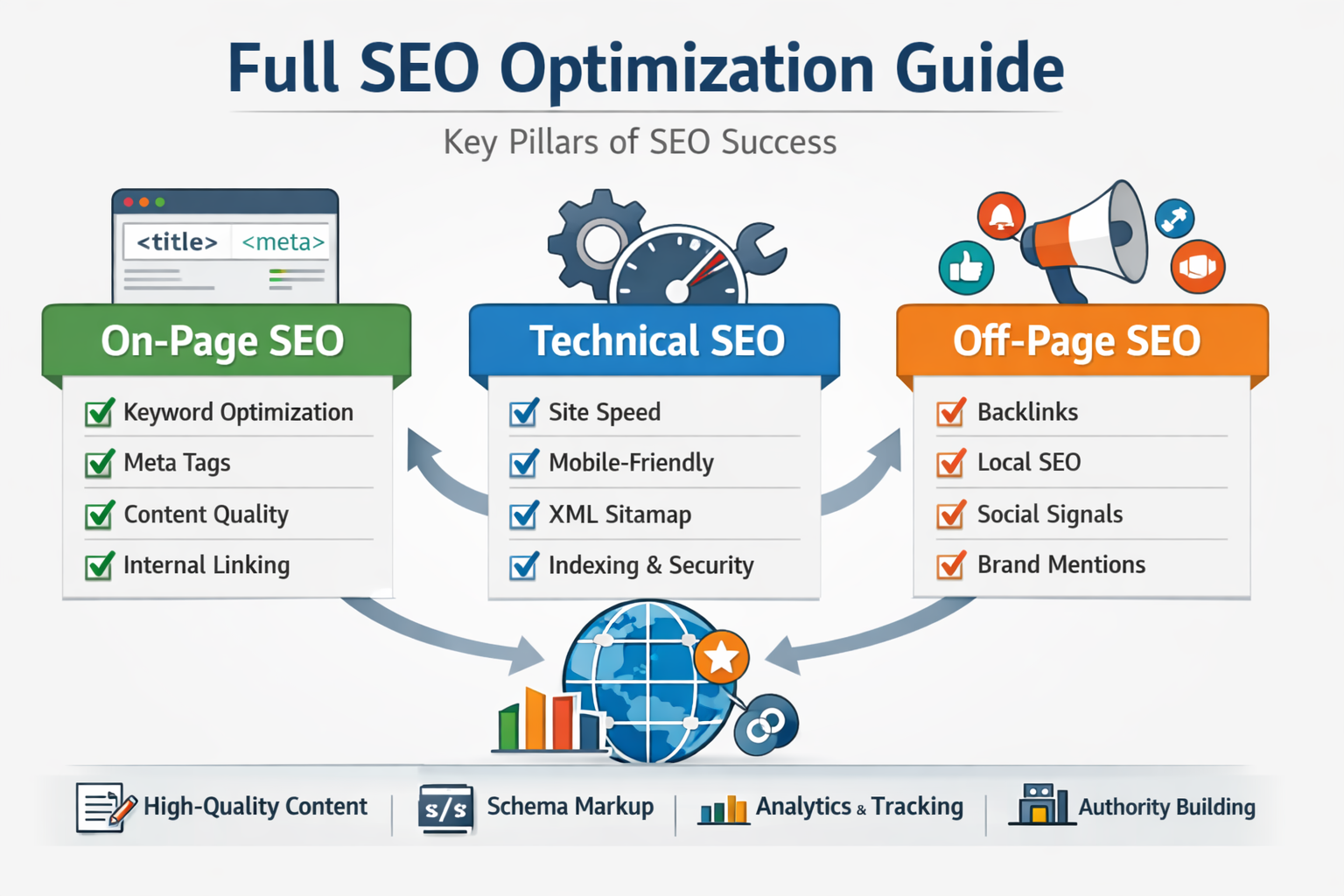
Search engine optimization is no longer about shortcuts or keyword stuffing. Today, full SEO optimization requires strategy, structure, and consistency. When done correctly, SEO improves visibility, builds authority, and drives long-term organic traffic without relying on paid ads.
This in-depth guide explains how to properly do full SEO, covering on-page SEO, technical SEO, off-page SEO, content optimization, and schema markup, exactly how professional publishers do it.
What Does “Full SEO” Actually Mean?
Full SEO refers to optimizing every ranking factor that search engines use to evaluate a website. It is not limited to keywords or backlinks alone.
Instead, full SEO includes:
- Search intent optimization
- High-quality content creation
- Technical performance improvements
- Authority building
- Structured data and indexing control
Each element supports the others. When one is missing, rankings suffer.
Step 1: Keyword Research With Real Search Intent
SEO begins with understanding what users are actually searching for.
Effective keyword research focuses on:
- Primary keywords (main topic)
- Secondary keywords (supporting phrases)
- Long-tail keywords (low competition, high intent)
- Semantic keywords (related meanings)
Instead of chasing high-volume terms, modern SEO prioritizes search intent:
- Informational (guides, how-to)
- Navigational (brand searches)
- Transactional (buy, download, subscribe)
When intent is matched correctly, rankings improve naturally.
Read: What Is Keyword Density? Complete SEO Guide
Step 2: On-Page SEO Optimization
On-page SEO tells Google what your content is about.
SEO Title Optimization
- Place the focus keyword at the beginning
- Keep length under 60 characters
- Make it compelling for clicks
How Long Should My SEO Title Be?
Meta Description Optimization
- Include the focus keyword once
- Write for humans, not bots
- Keep it between 140–160 characters
Proper Heading Structure
- Use one H1 only
- Use H2 for main sections
- Use H3 for sub-topics
This structure improves both readability and crawlability.
Step 3: Content Optimization
Search engines reward content that solves problems clearly.
High-quality SEO content should:
- Be original and in-depth
- Avoid fluff and repetition
- Use short paragraphs
- Include transition words naturally
- Answer related questions within the same article
Thin content fails because it lacks depth. Long-form content succeeds because it covers the topic completely.
Step 4: Internal and External Linking Strategy
Links help search engines understand context and authority.
Internal Links
- Connect related articles naturally
- Use descriptive anchor text
- Distribute link equity across pages
External Links
- Link to trusted, authoritative sources
- Avoid spam or low-quality websites
- Add value for the reader
A balanced linking structure improves crawl efficiency and topical relevance.
Step 5: Technical SEO That Actually Matters
Even the best content fails if the site is technically weak.
Core Technical SEO Elements
- Fast page speed
- Mobile responsiveness
- Clean URL structure
- HTTPS security
- XML sitemap submission
- Robots.txt configuration
Search engines prioritize user experience, and technical SEO directly affects it.
Step 6: Image and Media SEO Optimization
Images can drive traffic when optimized properly.
Best practices include:
- Descriptive file names
- Keyword-rich alt text
- Compressed image sizes
- Lazy loading for performance
Optimized media improves page speed and accessibility, both ranking factors.
Step 7: Schema Markup and Structured Data
Schema markup helps search engines understand your content type.
Common schema types include:
- Article
- NewsArticle
- FAQ
- Breadcrumb
- Organization
When implemented correctly, schema increases eligibility for rich results, improving click-through rates.
Step 8: Off-Page SEO and Authority Building
Off-page SEO builds trust beyond your website.
Key off-page signals include:
- High-quality backlinks
- Brand mentions
- Social sharing
- Referral traffic
Authority grows gradually. Paid or spammy links damage rankings permanently.
Step 9: Indexing, Crawling, and Google Search Console
SEO is incomplete without monitoring.
Always:
- Submit updated sitemaps
- Inspect URLs manually
- Fix coverage errors
- Monitor Core Web Vitals
- Remove accidental noindex tags
Search Console reveals how Google actually sees your website.
Google Search Central (Crawling, indexing, ranking explanations)
Also Read: What Is Crawlability and Indexability in SEO?
Step 10: Consistency and Content Updates
SEO is not a one-time task.
Winning websites:
- Update old content regularly
- Refresh titles and descriptions
- Add new internal links
- Improve outdated sections
Consistency signals freshness and reliability to search engines.
Common SEO Mistakes
Many websites fail due to avoidable errors:
- Duplicate or copied content
- Over-optimization of keywords
- Ignoring mobile users
- Publishing thin articles
- Buying low-quality backlinks
Avoiding these mistakes protects long-term rankings.
Finally
Full SEO optimization is a process, not a shortcut. When content quality, technical health, and authority work together, rankings follow naturally.
Search engines evolve constantly, but one principle remains unchanged:
Websites that genuinely help users always win.
By applying this full SEO strategy consistently, sustainable growth becomes achievable without risking penalties or volatility.
Related Articles
Increase Domain Authority Fast: Proven SEO Strategy
Best WordPress Plugin for SEO – Full Guide For 2026
How to Write SEO-Friendly Articles – Full Guide for 2026